AEO vs SEO: what's the difference and why it matters in 2026
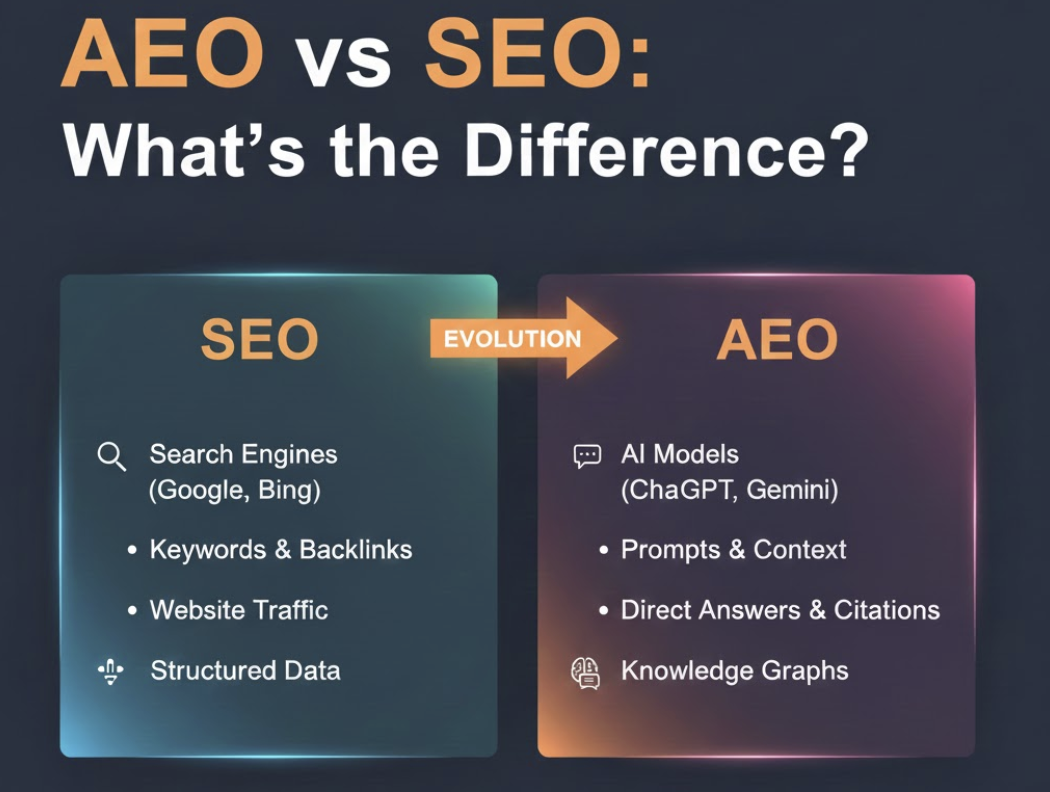
The search landscape is undergoing its most dramatic transformation since Google's inception. While traditional SEO focuses on ranking high in search engine results pages (SERPs), a new discipline called Answer Engine Optimization (AEO) is emerging to address the growing influence of AI-powered search platforms.
Understanding the difference between SEO and AEO—and why you need both—is crucial for any business that wants to maintain visibility in the evolving search ecosystem.
The search landscape is changing
Traditional search behavior is shifting rapidly. Here's what the data shows:
AI Search Adoption is Exploding
Over 50% of searches now include AI-generated summaries or answers. Platforms like ChatGPT, Perplexity, and Google's AI Overviews are changing how people find information.
Citation-Based Discovery
AI platforms don't just rank websites—they cite them as sources within comprehensive answers. Being cited in an AI response can drive high-intent traffic to your website.
Context-Rich Queries
Users are asking more complex, conversational questions rather than keyword-focused searches. "What are the best SEO strategies for e-commerce in 2026?" instead of "SEO e-commerce 2026."
Multi-Platform Search
People search across Google, ChatGPT, Perplexity, Claude, and other AI platforms. Optimizing for just one platform means missing significant portions of your audience.
Expert Insight
"By 2028, 75% of searches will include AI-generated answers. Optimizing only for Google means missing half your potential customers."
— Kristian Johansen, SEO Expert at OmniGanic
How AEO differs from traditional SEO
While SEO and AEO share some fundamentals, they require different approaches and optimizations:
SEO: Ranking for Keywords
Traditional SEO focuses on ranking high for specific keywords in search engine results. Success is measured by position in SERPs, click-through rates, and organic traffic volume.
Content Structure:
Optimizes for specific keyword density, title tags, and meta descriptions
Technical Implementation:
Focuses on traditional schema markup, internal linking, and page speed
Content Approach:
Keyword-focused content designed to match search queries
AEO: Being Cited as a Source
AEO focuses on becoming a trusted source that AI platforms cite when generating answers. Success is measured by citation frequency, source attribution, and the quality of referral traffic.
Content Structure:
Optimizes for comprehensive, accurate answers to specific questions
Technical Implementation:
Emphasizes structured data that AI can easily parse and understand
Content Approach:
Comprehensive, factual content that answers questions thoroughly
Why both matter in 2026
The key insight is that SEO and AEO aren't competing strategies—they're complementary approaches that together maximize your search visibility across all platforms.
Google Still Dominates Traditional Search
While AI search is growing rapidly, Google still processes billions of traditional searches daily. Ignoring SEO means missing massive traffic opportunities.
AI Platforms Drive High-Intent Traffic
Users who find your content through AI citations tend to be further along in their buying journey. They're looking for specific solutions, not just information.
Cross-Platform Visibility Compounds
Being visible in both traditional search results and AI citations creates multiple touchpoints with potential customers, building trust and authority.
Future-Proofing Your Strategy
The search landscape will continue evolving. A dual SEO/AEO approach ensures you're positioned for whatever changes come next.
See Your AI Visibility Score
Find out how visible your content is across Google, ChatGPT, Perplexity, and other AI platforms. Get a free analysis showing where you rank and how to improve.
Getting started with SEO and AEO
Here's how to implement a comprehensive search optimization strategy:
1Audit Your Current Performance
Analyze your visibility across both traditional search engines and AI platforms. Track where your content appears and how it's being cited.
2Optimize Content Structure
Create content that serves both SEO and AEO purposes. Use clear headings, bullet points, and structured data that both search engines and AI can understand.
3Implement Comprehensive Schema Markup
Schema markup is crucial for both SEO and AEO. It helps search engines understand your content and makes it easier for AI platforms to cite your information accurately.
4Focus on Question-Based Content
Create content that directly answers common questions in your industry. Use FAQ sections, how-to guides, and comprehensive topic coverage.
5Monitor Multi-Platform Performance
Track your performance across Google, ChatGPT, Perplexity, and other AI platforms. Adjust your strategy based on where you're seeing the best results.
6Maintain Content Accuracy
AI platforms prioritize accurate, up-to-date information. Regular content audits and updates are essential for maintaining citation frequency.
The businesses that understand and implement both SEO and AEO strategies now will have a significant competitive advantage as the search landscape continues to evolve. Our network layer optimization handles both traditional SEO and cutting-edge AEO automatically.
This isn't about choosing between old and new—it's about embracing a comprehensive approach that maximizes your visibility wherever your customers are searching. Test your domain free to see how we'd optimize your site for both search engines and AI platforms.
Frequently asked questions
Should I focus on SEO or AEO first?
Start with a foundation of good SEO practices, then layer in AEO optimizations. Many AEO techniques build on existing SEO fundamentals, so you don't need to choose one or the other.
How do I track AEO performance?
Monitor citations across AI platforms, track referral traffic from AI sources, and use tools that can identify when your content is being referenced in AI-generated answers. Learn more about AI visibility scores and test your domain to see how often your content appears in AI responses.
Is AEO just a trend, or is it here to stay?
AEO represents a fundamental shift in how people access information. As AI platforms become more sophisticated and widely adopted, AEO will become as important as traditional SEO.
Related Articles
SEO vs AEO vs GEO: What's the Difference?
Understand the key differences between Search Engine Optimization, Answer Engine Optimization, and Generative Engine Optimization.
What is AI Visibility Score?
Learn how to measure your content's performance across AI platforms and improve your visibility in AI-generated responses.
SEO Automation Guide: AI-Powered Optimization Strategies
Discover how AI automation is revolutionizing SEO with faster implementation and better results than traditional manual approaches.
Why Traditional SEO Agencies Are Becoming Obsolete
Learn why businesses are moving away from expensive SEO agencies toward automated, AI-powered optimization platforms.