What is the difference between SEO, AEO and GEO?
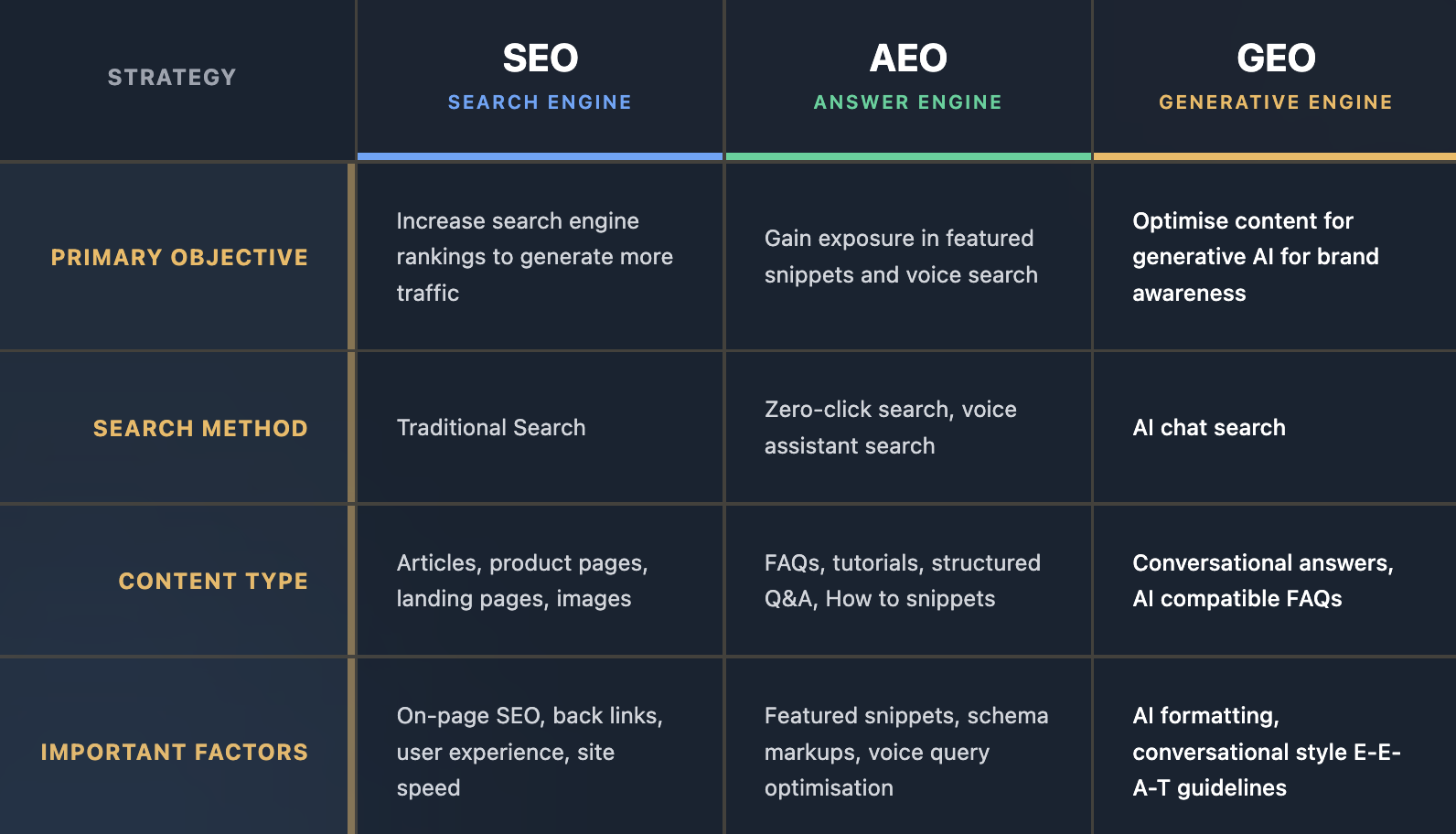
SEO targets traditional search engines like Google, AEO optimizes for AI answer engines like ChatGPT and Claude, while GEO focuses on generative AI platforms that create original content responses. Each requires different strategies as search behavior evolves from clicking links to receiving direct AI-generated answers.
TL;DR - Key Differences
SEO (Search Engine Optimization)
- • Google, Bing rankings
- • Click-through optimization
- • Keywords & backlinks
- • SERP visibility focus
AEO (Answer Engine Optimization)
- • ChatGPT, Claude citations
- • Direct answer optimization
- • Structured content format
- • AI comprehension focus
GEO (Generative Engine Optimization)
- • AI content generation
- • Context & attribution
- • Training data influence
- • Synthesis optimization
SEO (Search Engine Optimization)
What is SEO?
SEO optimizes websites to rank higher in search engine results pages (SERPs) on platforms like Google, Bing, and Yahoo. The goal is to increase organic visibility and drive qualified traffic through strategic content and technical optimization.
Core SEO Elements:
- • Keyword research and targeting
- • On-page optimization (title tags, meta descriptions)
- • Technical SEO (site speed, mobile-friendliness)
- • Link building and domain authority
- • Content quality and relevance
SEO Success Metrics:
When to Focus on SEO:
AEO (Answer Engine Optimization)
What is AEO?
AEO optimizes content to be discovered, understood, and cited by AI answer engines like ChatGPT, Claude, Perplexity, and Google Bard. Instead of ranking in search results, the goal is to have your content referenced in AI-generated responses.
Core AEO Elements:
- • Structured, conversational content
- • Direct answers to common questions
- • Authoritative sources and citations
- • Clear content hierarchy (H1, H2, H3)
- • FAQ sections and Q&A formats
AEO Success Metrics:
When to Focus on AEO:
GEO (Generative Engine Optimization)
What is GEO?
GEO optimizes content to influence how generative AI models create original responses. This involves understanding how AI systems synthesize information from multiple sources to generate comprehensive, contextual answers that go beyond simple citations.
Core GEO Elements:
- • Contextual content relationships
- • Multi-faceted topic coverage
- • Semantic content connections
- • Cross-referenced information
- • Training data optimization
GEO Success Metrics:
When to Focus on GEO:
Side-by-Side Comparison: SEO vs AEO vs GEO
| Aspect | SEO | AEO | GEO |
|---|---|---|---|
| Primary Goal | Search rankings | AI citations | AI synthesis |
| Target Platforms | Google, Bing, Yahoo | ChatGPT, Claude, Perplexity | All generative AI models |
| Content Focus | Keyword optimization | Question-answer format | Contextual relationships |
| Success Metric | Click-through rate | Citation frequency | Content influence |
| Timeframe | 3-6 months | 1-3 months | 6-12 months |
| Implementation | Technical + Content | Content + Structure | Strategy + Context |
Which Strategy Should You Choose?
Choose SEO If:
- • You need consistent organic traffic
- • Competing in established markets
- • Running e-commerce or lead gen
- • Targeting local/geographic searches
- • Have resources for long-term strategy
Choose AEO If:
- • Creating educational content
- • Building thought leadership
- • Targeting question-based queries
- • Focusing on B2B audiences
- • Want faster visibility wins
Choose GEO If:
- • Planning for AI-first future
- • Creating comprehensive guides
- • Building industry authority
- • Complex topic expertise
- • Long-term strategic thinking
The future: integrated optimization strategy
The most successful businesses in 2025 won't choose just one approach—they'll implement an integrated strategy that combines all three optimization methods. Here's why:
Overlapping Benefits:
- • SEO content can be optimized for AEO citations
- • AEO structure improves traditional search performance
- • GEO strategies future-proof both SEO and AEO efforts
- • All three improve overall content quality and user experience
Recommended Allocation:
Expert Insight
"The companies that will dominate search in 2025 are already integrating SEO, AEO, and GEO strategies. It's not about choosing one—it's about understanding how they work together to create comprehensive digital visibility across all platforms where your audience searches for information."
- OmniGanic Digital Strategy Team
Related Articles
AEO vs SEO: Complete Comparison
Deep dive into the differences between traditional SEO and Answer Engine Optimization strategies.
AI Visibility Optimization
Learn how to optimize your content for discovery and citation across AI platforms and search engines.
Automated SEO & AEO
Discover how AI-powered tools can optimize for SEO, AEO, and GEO simultaneously.
Complete Organic Traffic Guide
Master organic traffic growth with comprehensive SEO, AEO, and GEO strategies for 2026.
Ready to Implement All Three Strategies?
Get a comprehensive audit covering SEO, AEO, and GEO opportunities for your website. We'll create a custom optimization strategy that maximizes your visibility across traditional search engines and AI platforms.